2.3 Cost Logic: Token vs. Payroll
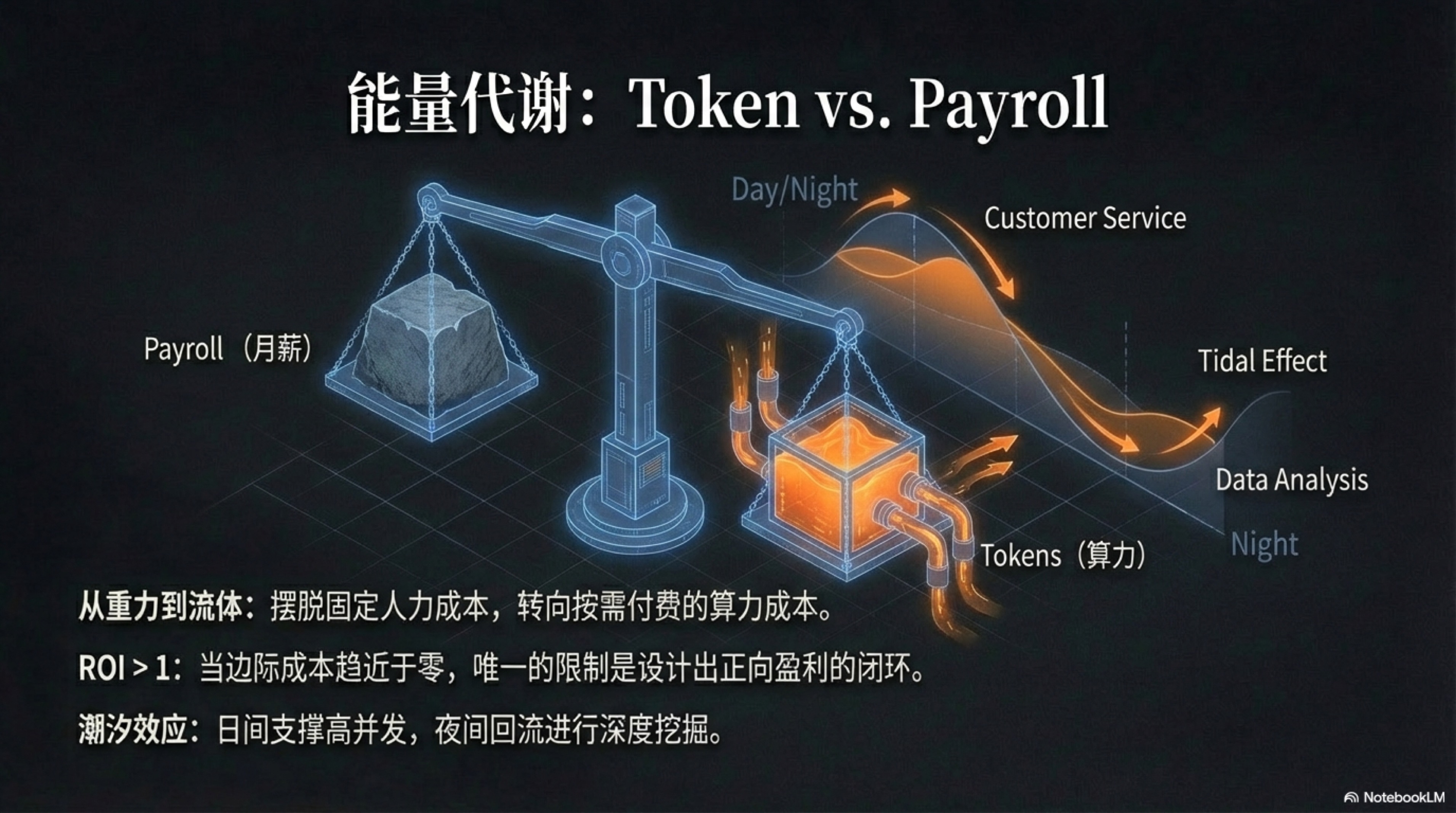
At the dawn of the new species "Autonomous Entity," we must temporarily put away our fascination with grand narratives and face a fundamental question that no business model can avoid: What is its cost of survival? If the operating cost of a "Silicon-based Legion" composed of AI is unbearably high, then the dream of a "One-Person Unicorn" will ultimately be just an expensive laboratory toy.
The emergence of Meta-Leverage not only overturns the organizational form of productivity but also fundamentally reshapes the cost structure of enterprises. It thrusts us from an old world based on "people" and settled by "Payroll" into a new world based on "computation" and settled by "Tokens." But please be sure to break a common misconception first: AI is not free magic. It is more like a new type of industrial electricity that can be used instantly. You need to pay for it, but its price is absurdly low.
It is time to do the math. A cold and cruel calculation that determines the future form of enterprises.
The "Gravity" Crushing Organizations: The True Cost of a Carbon-based Employee
Imagine, in a top office building in Shanghai, what is the "total cost" to keep a senior software engineer, Wang Wei, "alive"? This is by no means just his pre-tax monthly salary of 50,000. This account is an iceberg piled up by countless "taken-for-granted" details.
First is the visible Direct Cost. Besides the monthly salary, the company also needs to pay for his "social insurance and housing fund," which is usually 30%-40% of the salary, meaning an extra expenditure of nearly 200,000 per year. Don't forget the year-end bonus, project bonus, and stock options—these carrots hung to motivate him to "jump higher," each costing a fortune.
Then is the invisible Environmental Cost. Wang Wei needs a workstation, even if only five square meters. In the core area of a city where land is gold, behind this are thousands of yuan in monthly rent, property management fees, and utilities. He needs a top-configured MacBook Pro, licensed development tools, design software, and project management platform authorizations. These "hoes and shovels" of the digital age are all continuously "bleeding" money. He also needs coffee, snacks, and team building. These necessary lubricants to maintain "humanity" are also eating into profits.
Adding these up, the annualized cost of a "Carbon-based Employee" can easily reach more than twice his nominal salary, easily breaking the million mark. However, this is still only the part of the iceberg floating above the water.
The real cost black hole is the Management Cost that cannot be quantified but happens all the time. To make Wang Wei work efficiently, his manager needs to have a "one-on-one" communication with him every week; the project manager needs to pull him into countless requirement review meetings and progress synchronization meetings; HR needs to design a career development path for him. These communications, coordination, alignment, incentives... constitute the "management entropy" we mentioned in Chapter 1. It is like an invisible gravity; the more people in the company, the stronger this gravity becomes, eventually confining the entire organization firmly to the ground, making expansion difficult. This is the price that must be paid for hiring carbon-based life—a heavy "Survival Cost" that cannot be exempted regardless of wind or rain.
The "Thrust" Breaking Gravity: The Astonishing Bill of a Silicon-based Employee
Now, let us turn to the other page of the ledger and look at the cost of a "Silicon-based Employee."
Suppose we need to complete a task that would take Wang Wei a week in the past: design and write a backend API for a new function, including database schema, all CRUD (Create, Read, Update, Delete) endpoints, and a complete set of unit tests.
We hire a "Silicon-based Employee"—for example, calling the most advanced Claude 4.5 Opus model API once. Completing this task may require processing and generating a total of about one million Tokens[^1]. According to currently public prices, what is its approximate cost? Less than twenty dollars.
Let us repeat: Twenty dollars.
This is not even enough to pay for Wang Wei's one-way taxi fare from home to the company, nor enough for his lunch and coffee expenses for a day. According to industry analysis, in specific tasks like code generation, the cost-benefit ratio between AI models and human developers can reach a staggering figure—99.9% cost savings, with efficiency differences in some scenarios as high as tens of thousands of times[^2].
This is no longer a difference in magnitude, but a blow from another dimension.
The cost structure of "Silicon-based Employees" completely overturns traditional business logic. It has no "social insurance and housing fund," no "office rent," and no "mood swings." You don't need to provide it with stables and fodder. It is more like an ultimate "gig economy": when you need it, you "wake it up" via API call, and it completes the task at nearly the speed of light; when you don't need it, it "disappears" into the cloud without generating any "Survival Cost." This is a pure, pay-as-you-go "Utility Cost."
The significance of this paradigm shift in cost structure goes far beyond "cost reduction and efficiency increase." It brings a brand-new, almost counter-intuitive economics of scale.
The Nuclear Reactor of Growth: When ROI is Greater Than 1
In the past, the path of corporate expansion was linear: to double the output, you had to bear nearly double the new manpower and management costs. This is a heavy shackle; growth itself generates huge friction.
Now, imagine we possess a "Magic Value Reactor": every time you invest one dollar worth of Tokens (computing cost), it can stably create two dollars worth of code, design, or media content. When the Return on Investment (ROI) is consistently greater than 1, and the marginal cost of adding a new "employee" (calling an API once) is almost zero, what would you do?
The answer is obvious: you would run this machine tirelessly and endlessly until it occupies every corner of the market you can think of.
This is precisely the financial cornerstone on which the "One-Person Unicorn" can be established. In AI-native enterprises, growth is no longer constrained by financing ability or recruitment speed. The only limit becomes your ability to design automated business closed loops with "ROI > 1." As long as you can find a profitable scenario, you can theoretically hire an infinite-scale "Silicon-based Legion" working 24/7 to execute your commercial will. You can simultaneously launch "blitzkriegs" in a hundred niche markets, flooding every keyword with AI-generated content; you can create a thousand micro-SaaS tools meeting specific niche needs overnight without bearing the salary burden of a single employee.
With the intensification of the "arms race" among large tech companies, the price of AI models continues to drop due to market competition, while capabilities improve rapidly along Moore's Law[^3][^4]. This scenario, which sounded like science fiction in the past, is becoming a cold and alluring commercial reality.
Of course, this depicts a nearly ideal picture. Its core premise is that AI agents possess extremely high autonomy, requiring only very light auditing and intervention from humans. Otherwise, once human managers need to intervene deeply and supervise hundreds or thousands of concurrent tasks simultaneously, the "Attention Residue" problem we discussed earlier will once again become the ultimate ceiling of growth, pulling theoretical infinite scalability back to cruel cognitive reality. An AI system that cannot run autonomously, no matter how low its Token cost is, will eventually be swallowed by its architect's expensive "Attention Cost."
Therefore, while excited about the cheapness of this "Silicon-based Legion," we must look deeper. How is a truly autonomous agent capable of realizing the above vision constructed internally? How does it think, remember, and evolve? In the next chapter, we will move from the macro perspective of economics to the micro level of engineering, dissecting the smallest unit constituting the "One-Person Unicorn"—that autonomous agent known as the "Silicon-based Employee."
[^1]: One million Tokens here is an estimate. A backend task of medium complexity, including requirement understanding, code generation, iterative modification, test case writing, etc., involves multiple interactions with the model. A total Token consumption reaching the million level is a reasonable range. Actual consumption depends on task complexity, model capability, and engineering practices.
[^2]: An analysis article published in 2025 points out that in raw code generation tasks, the cost-effectiveness of specific AI models is tens of thousands of times that of human developers, revealing the huge gap in pure "labor" output between the two. Reference dev.to, "AI models are 99.9%+ more cost-effective than human developers...", August 20, 2025. Article Link
[^3]: Industry price monitoring reports show that the prices of top large language models have dropped by over 60% in the past year, and this trend is expected to continue. Fierce market competition is rapidly driving down the overall usage cost of AI. Reference intuitionlabs.ai, "LLM API Pricing Comparison (2025)...", January 23, 2026. Article Link
[^4]: Future price forecasts further confirm this trend. A 2026 outlook report predicts that with the emergence of more efficient models and reduced hardware costs, the price of mainstream LLMs may drop by another 50% on the existing basis, which will further amplify the economic advantage of AI. Reference cloudidr.com, "Complete LLM Pricing Comparison 2026...", December 29, 2025. Report Link