Chapter 5. Asset Architecture: Reusable Infrastructure
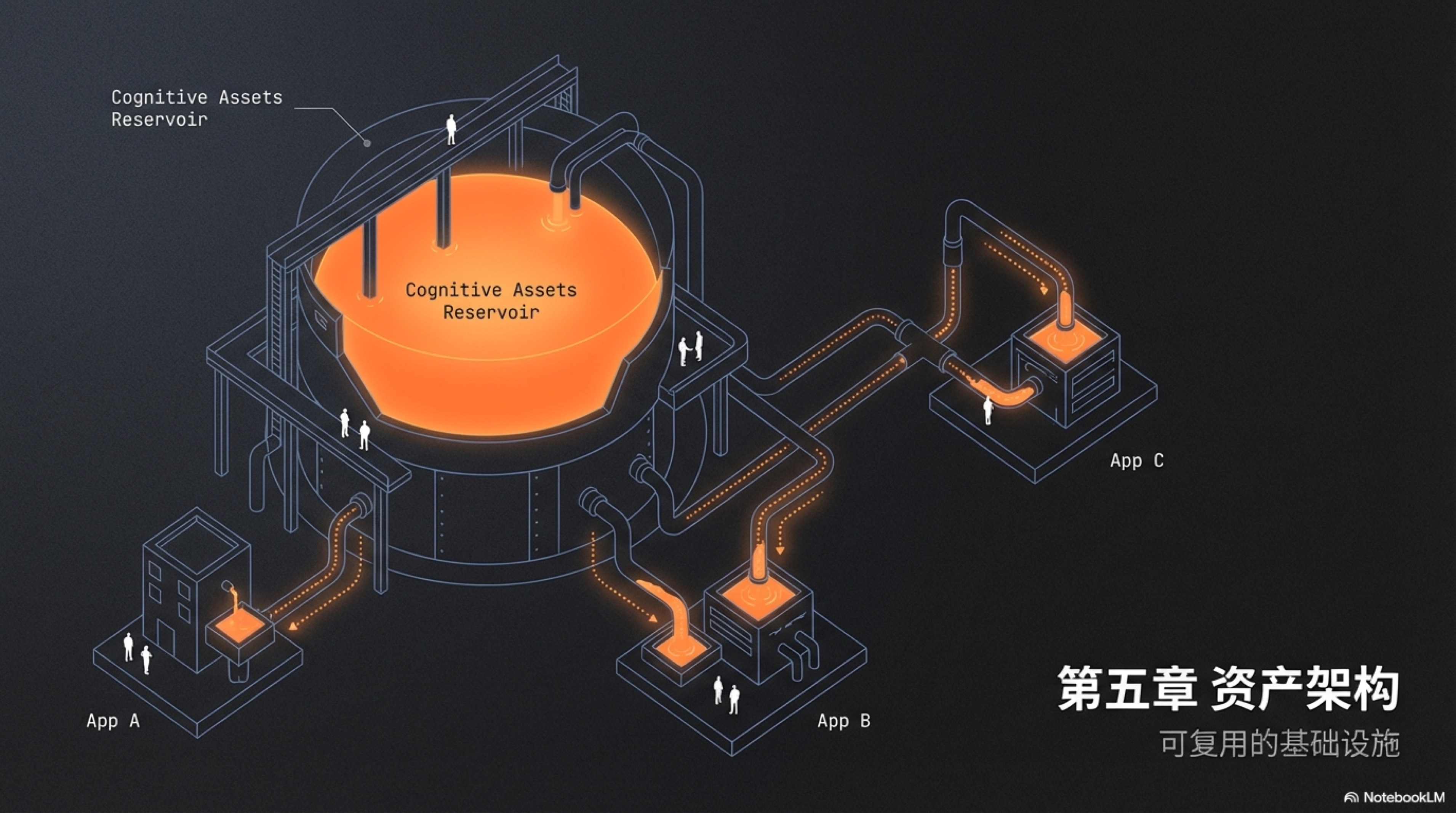
In previous chapters, we delved into the two core elements that constitute an AI-native enterprise: the "Silicon-based Employee" as the minimal functional unit (Chapter 3: Individual Anatomy), and the "Digital Governance System" that ensures these units collaborate efficiently and safely (Chapter 4: Organizational Governance). We now possess agents with a probabilistic nature, multi-layer memory systems, active heartbeats, and an embedded PDCA cycle as their evolutionary engine. Simultaneously, we have established a macro-management framework for them based on "Digital Taylorism" and an "AI Constitution." We have designed the "physiological" and "social" structures of this new species.
However, for a living organism to move from a fragile individual to a thriving population, it must have a Habitat that supports its survival, reproduction, and expansion. This habitat provides not only shelter but, more importantly, a continuous stream of resources that can be dominated and utilized. For the "One-Person Unicorn," this habitat is the Asset Architecture we will explore in depth in this chapter.
Traditional enterprise growth is often accompanied by heavy "physical inertia." Opening a new business line usually means building a new team, purchasing new software, and establishing new channels. It's like having to build a brand-new factory from scratch every time you want to manufacture a different model of car. AI-native enterprises, however, completely upend this logic. Their core philosophy is to view the enterprise itself as a giant, reconfigurable "bucket of LEGO bricks." This bucket is filled with various standardized "bricks"—our "assets." The idea of packaging business capabilities into freely combinable modules is the essence of the "Composable Enterprise" concept proposed by information technology research firm Gartner, which centers on modularizing technology and business to flexibly adapt to rapid market changes.[^1] The value of an enterprise is no longer just reflected in the specific product (car or spaceship) it finally assembles, but more so in the quality, quantity, and interoperability of the bricks themselves.
The mission of this chapter is to define exactly what bricks should be in this "LEGO bucket" and how we should design, accumulate, and manage them. This is the final piece of the puzzle to land theory into sustainable business value. It explains how a one-person enterprise can escape the curse of linear growth and achieve exponential expansion and anti-fragile survival through the reuse and combination of assets.
[^1]: Gartner defines this as an organization that delivers business outcomes and adapts to the pace of business change through the assembly and combination of "Packaged Business Capabilities" (PBCs). See Gartner, "Composable Enterprise", Gartner Trends. Official topic page: https://www.gartner.com/en/trends/composable-enterprise